Equipped to Lead and Succeed
These members of the Class of 2026 have full-time jobs or full-time graduate school lined up. What will they be doing? How did they land those positions? What’s their career advice to current students?
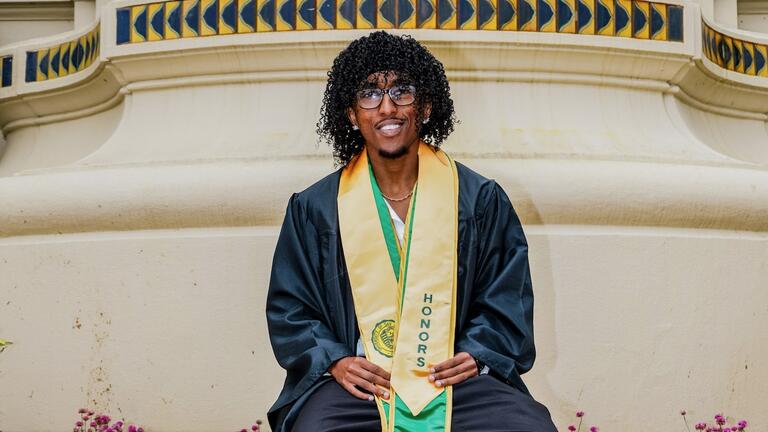
Natty Michael, Finance
I’ll be starting at eBay in San Jose as a financial analyst this August. I’ll be part of their Financial Futures program. For two years, you rotate through three areas of finance, eight months at a time, to dibble-dabble and get a better sense of what you’re interested in. I’m not exactly sure what I want to do in finance yet, so getting experience and meeting different people across functions is ideal. It’s like getting paid to apprentice at a high level.
I got a return offer to the Financial Futures program through an internship with eBay last summer. It was a 12-week program, and they told us from the get-go to put our best foot forward because they might extend offers afterward. During my junior year, I was applying for internships on LinkedIn, ZipRecruiter, and Handshake. But then at a career services event, I met a friend who recommended the Financial Futures program, and I applied. You never really know who that person is who could change your life.
My career advice? Be curious. Curiosity takes you a long way, not just in classes but in the workplace. Ask questions. There are no stupid questions, and it’s better to ask than pretend you know something. I’m introverted, but during my internship I made it a point to talk to one or two new people every day, set up coffee chats, and ask what they do and how they got there. That’s what helped me during the internship and led to a return offer. I’d also recommend taking classes with Professor Frank O’Hara — he gives very direct, real-world advice.
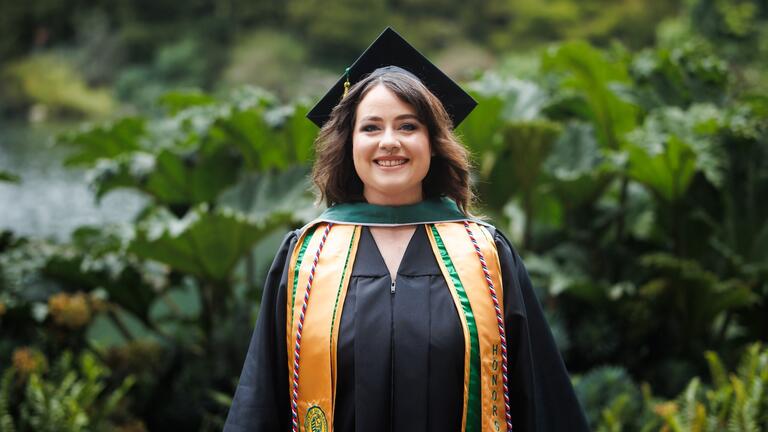
Tara Newland, BA in Fine Arts and in Design
I’ll be starting the MFA program in visual arts at the Herron School of Art and Design at Indiana University in August. I did a lot of research on it and I just kind of fell in love with it. I want to do multidisciplinary art, and Herron offers that. I don’t have to just stick with painting.
My career advice: Try things you’re not familiar with. Take classes outside of your comfort zone. It doesn’t matter if you’re bad at first — keep pushing yourself and pushing your skill level. Take classes with Eric Hongisto, Susan Wolsborn, and Jenifer Wofford. In their classes I got to work in so many different mediums that I wasn’t skilled in yet. I hadn’t really painted until about a year ago — and now most of my portfolio is paintings.
In my first year I was struggling in an app-building class. I took it to fulfill my math requirement, and I was feeling really frustrated, like I wasn’t doing well at all. But then my professor, David Wolber, asked me if he could show my work at a talk. That was one of those moments where I was like, I think I might not be good at something, but somebody else clearly thinks I am.
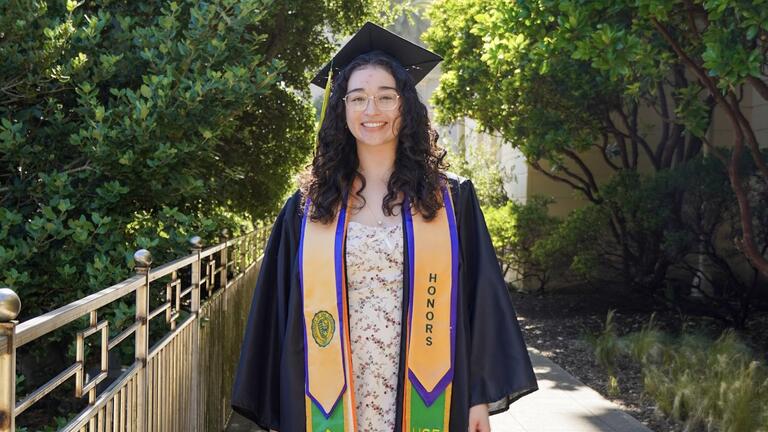
Katie Chaleunphonh, Engineering
I’ll be working at Latitude 48 Engineers in Seattle — I’m from Seattle originally, so I’m moving back home. It’s a civil engineering firm. They do affordable housing, schools, offices, things like that. I’ll be helping the senior engineers with their projects, working mainly on site planning, stormwater management, utility coordination, and permitting.
I interned at Latitude 48 Engineers two years ago, the summer after my sophomore year. I had an internship last year with Cahill Contractors in the Bay Area, but kept in touch with Latitude 48 and will be starting full-time with them next month. The way I got that first internship was through an architect my dad knew, who knew the civil engineers at the company. It took several people to get me connected to the company. Your network could be your grandma’s next-door neighbor’s hairdresser. You never know where you’re going to find your next job.
My career advice? Believe in yourself. That’s something I definitely struggled with freshman and sophomore year — can I really become an engineer? Part of my nervousness came from not seeing a lot of representation in the field, being a woman, being a woman of Asian descent. But continuing on naturally gave me more confidence, because I was passing classes, understanding things, doing well, and becoming a better engineer. I’d also say: get involved in your department. I’ve TA’d, I work in the engineering makerspace, and I’ve done research with my professor, Hana Mori. You get out what you put in!
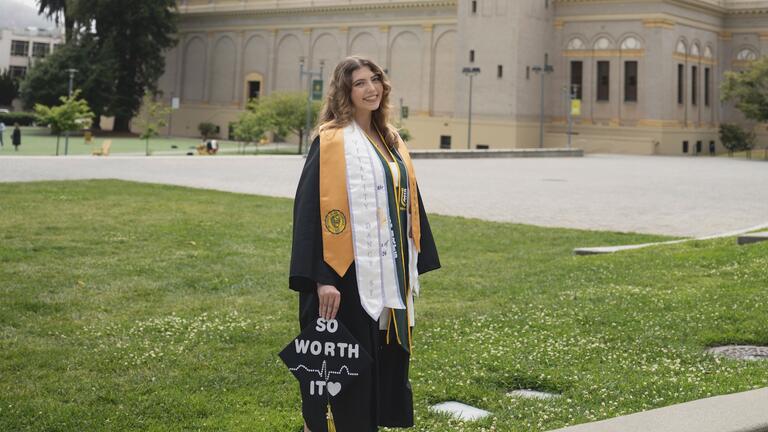
Courtney Houtz, Nursing
I’ll be working at the Children’s Hospital of Colorado in Aurora, just outside Denver, in the pediatric intensive care unit. I’ll be part of their new-grad residency program.
I knew I wanted to work with kids, so I started looking up children’s hospitals in areas where I thought I might want to live. I looked in California, Oregon, Washington, a little bit on the East Coast, and Colorado. Children’s Hospital of Colorado came up, and I went to their website, applied when the application opened, and got an interview. I also reached out to alumni from our nursing program who had worked there and heard really good things. The interview was a group interview, and I felt like I really got along with the faculty interviewing me. After that, I got the offer.
My advice? Keep your mind open. I originally was like, I’m staying in the Bay Area, this is where I’ve always been, I’m too scared to look anywhere else. But if I had done that, I wouldn’t have gotten this opportunity. There’s so much out there that if you’re not willing to look for it, you might never find it. Talking to alumni really helped with that, too — just hearing about their experiences and knowing they were supportive if I decided to go to that region or hospital.
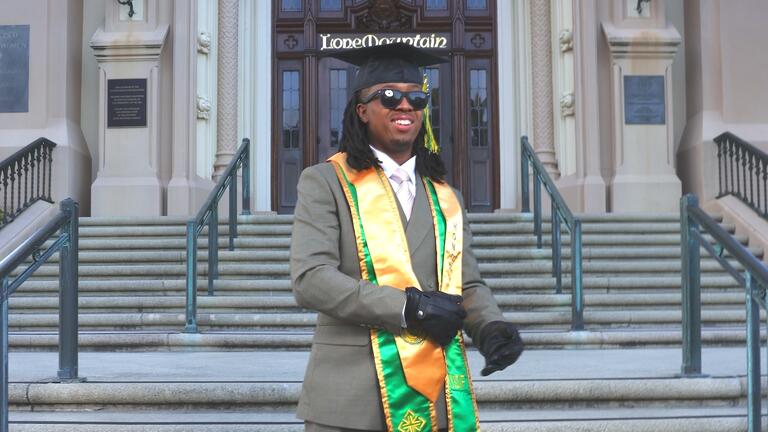
Jayden Calhoun, Politics
I’m a clerk at Hanna Brophy, a workers’ compensation law firm in Oakland, where I assist attorneys, paralegals, and legal assistants. I started in February and currently work three days a week. After graduation, I’ll transition to full-time. I plan to apply to law school in the fall.
I got connected to Hanna Brophy through Allison Wang at USF School of Law. I reached out to her, and we had regular conversations about my interests and what I want to do. She referred me to the managing partner at Hanna Brophy, which led to an interview and the job. I also did a lot of outreach, connecting with people on LinkedIn and setting up coffee chats. I was a Leo T. McCarthy Center fellow in Sacramento, where I worked with the California State Assembly and spoke with people in government and law.
My career advice: Take classes with Kouslaa Kessler-Mata and Patrick Murphy. They’ll help you understand the legal profession from different perspectives. Also, network. A lot of people are intimidated by it, but I’ve learned to approach it like a regular conversation with another human being. I’m from South Central Los Angeles and didn’t have an existing network. I asked people in my desired line of work about their experience and respective journeys. I always concluded each coffee chat with a “Who do you know that…” question, as it often resulted in the people I spoke with connecting me to other people in their networks. You never know which connection might open a door. I worked at In-N-Out during my freshman year and had different jobs along the way, but the main thing is building skills wherever you are, which helps increase your chances of landing where you want to be.
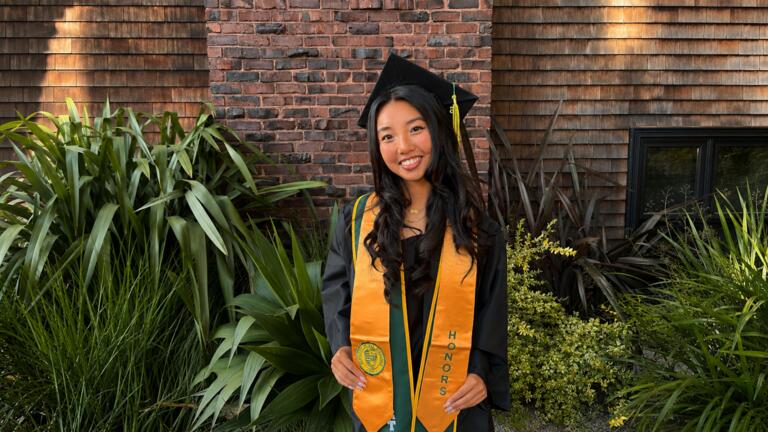
Kayla Kim, Accounting
I’ll be working as an auditor at Withum, an accounting firm, in their San Francisco office.
I didn’t start job-searching until my first semester of senior year. I went to the Meet the Firms event on campus and tried to network with as many tables as possible and get a lot of people’s LinkedIns. But it wasn’t actually what led to my job at all. It was a connection with a classmate in a tax class. He asked me, “Do you want a job?” He’d been interning at Withum and they asked him if he could refer anyone from school. He connected me with the recruiter at Withum and I applied.
My career advice? Take classes with John Koeplin, Tatiana Fedyk, and Diane Roberts. And make the most of every opportunity to build friendships and connections. I didn’t have any accounting internships at all, but what I learned from talking to recruiters is they don’t care if you don’t know what you’re doing, as long as you’re open to learning. It’s really about just being kind, communicating, following up, and being open — choosing to live by faith rather than fear.
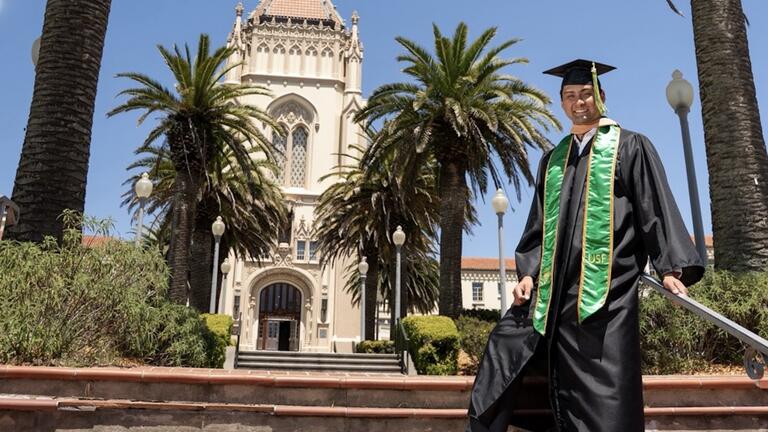
Anthony Gill, Finance
I’ll be working at CliftonLarsonAllen (CLA) at their office in downtown San Francisco. They do audit, tax, wealth management, and consulting. I’ll be starting as an associate in audit and tax in early September.
I got the job through an internship at CLA that ran from January to April. From my first day, I thought of that internship as a long interview. I tried my best and got the return offer. As for how I got the internship — like anyone else, many, many applications to different firms, but I made sure I was actually interested in the firm. I knew what they’re known for, which is construction accounting, and I was very interested in that. I applied through LinkedIn, made sure my resume was applicable to the work I’d be doing there, and sent follow-up emails after my interview, to thank them.
My advice? Focus on your own craft, and try not to think too much about what others are doing. I started at USF as a hospitality major. Working in a restaurant and all that, I realized I didn’t like it, so I switched into finance. There’s nothing wrong with wandering. Especially going into college, that’s one of the best things you can do. On the practical side: adjust your resume to each specific job, and put projects from your classes in there. Being a college student, the main experience you have is in school, so treat those projects as real, go into detail about what you did, and try to make them as applicable to the real world as possible. And be yourself. I noticed one of the gentlemen interviewing me had a Giants poster in the background, and me being a baseball fan, I commented on that. Just try to make a genuine connection any way you can.
I’ll also say this: I’m a third-generation Don. My grandfather graduated from USF in 1964. My father graduated in 1986 and came back for his MBA. Knowing that they walked the same halls that I do really kept me going. I became obsessed with graduating from here, and I never gave up.