Passion for Justice
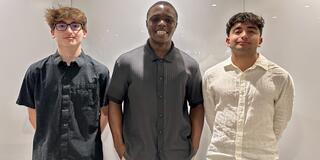
A team of USF students began the spring semester with a huge win: Their app, Globana, was named one of 2025’s Most Disruptive Business School Startups by business school news outlet Poets & Quants.
Fintech app Globana was also a winning entry at USF’s Innovation Summit last year. Founded by economics major Chibuike Nkemere ’26, international business major Datis Shoushary ’26, and computer science major Jake Abendroth ’27, Globana was conceived when Nkemere ran into issues sending money to family in Nigeria.
Because he didn’t have the documentation necessary to open a Nigerian bank account (a national identification number, or NIN), and his family members there didn’t have the American documentation necessary to open U.S. bank accounts (social security numbers), it was almost impossible to digitally transfer money back and forth.
So Nkemere teamed up with Shoushary and Abendroth to create Globana, which he describes as a “multi-currency digital wallet enabling unbanked individuals to store, send, and receive money internationally while accessing U.S.-issued virtual cards for online purchases.”
Professor Johnathan Cromwell, founder of the USF Innovation Summit, said the team’s work is driven by a need the students experienced themselves, and they have access to real users who can help them shape the app to meet those needs.
“As a result, Globana is able to solve the problem better than potential competitors, giving them a chance to get bigger and become successful,” Cromwell said.
Here, Nkemere describes the app and the inspiration behind it.
Tell us how Globana works.
It’s a digital wallet that operates as a full neo-bank. Whereas competitors may offer digital wallets that can be used only for payments, we’re creating an app that acts like a full-service financial institution. With Globana you get bank accounts with account numbers and routing numbers, as well as debit cards. We’re partnered with a Nigerian bank so that when you sign up with Globana from Nigeria, you immediately have both a Nigerian bank account and a U.S. bank account. You get a debit card that can pull from either the Nigerian or the American accounts in your name, which makes purchasing from U.S. stores easier for Nigerians.
This is important because Nigeria is considered a high fraud region, and many transactions on debit cards based there — especially recurring subscriptions from providers like Netflix or Apple Music — are blocked due to increased risk. We offer debit cards issued on US BINs, or bank identification numbers, to solve this, and so we’re able to act as the middleman to open doors of commerce that were previously closed to people in Nigeria.
And the idea was the result of your own experience?
It was the result of my own frustration! I was trying to send money to my cousin in Nigeria, and I ran into roadblocks at every turn. I couldn’t use a local bank account to deposit money, as I’m American and don’t have the required NIN to set up a Nigerian account. And the peer-to-peer payment platforms that we use so regularly in America, like CashApp or Zelle, require U.S.-based documentation like a bank account or a social security number, which my cousin didn’t have and couldn’t obtain. On top of that, existing remittance services charge extremely high conversion rates and fees for both the sender and receiver. I thought there had to be a better way —a global digital wallet that could utilize the currencies of multiple countries. Luckily, Datis and Jake were behind the idea, and with our combined perspectives and skills from the economic, international business, and computer science disciplines, we were able to create something that worked.
What’s next for Globana?
Next is to properly scale Globana. As we grow, it’s important to us that users’ experiences are seamless and identical. The goal is to expand into Europe next, as there are so many Nigerians in Europe and we want to build upon our base. In order to remain true to the vision, we want to grow in depth first, not just width, meaning we want to be sure we’re providing the most comprehensive experience possible to as many Nigerians as possible before we start expanding to other countries and currencies.
And what’s next for you? This is your last semester at USF, isn’t it?
It is! I’ve accepted a role as a strategy and management analyst at the Bank of America headquarters in Charlotte, North Carolina, where I interned last summer. But even though it means that I’ll step away from day-to-day operations at Globana, I’ll remain committed to its vision and to helping realize it. My long-term plan is to continue to support its development and further its growth, and I hope to go to business school to help facilitate that.
What about your experience at USF do you think helped you most while developing Globana?
The instruction and support, for one. Professor Johnathan Cromwell started the Entrepreneurship & Innovation Initiative at USF and was an invaluable resource when it came to support and validation for Globana. He’s the reason we entered the Innovation Summit in the first place, and he made sure to put us in touch with the people who could help further our goals. The access USF provides in terms of networking is also top-notch. Because the city is so small and USF and its professors and alumni are so well-regarded, we encountered many tech leaders willing to share their experience and expertise. One of these was Ken Kruszka, the first person to ever send $1 around the world by mobile transfer. As someone who’s hoping to create an entirely mobile experience using global currency transfers, that was incredible.