What is AI Good For?
When ChatGPT arrived in late 2022, some universities banned it. Some ignored it. Some declared it the future and raced to adopt it.
USF paused.
“When it comes to AI, we challenge it,” says USF President Salvador D. Aceves ’83, EdD ’95. “We talk about ethics and implications, about bias and hallucinations, about who is included and who is excluded. Most of all, we ask how we can use machines in the service of humans.”
Doing the Math on Democracy
Professor Ellen Veomett wants to make sure every vote counts. In her Computational Democracy and Equity Lab at USF, she and her computer science students use AI to detect gerrymandering.
Gerrymandering is the manipulation of electoral district maps to benefit one group at the expense of another. It can be partisan, favoring one political party, or racial, reducing the voting power of minority voters. “If people don’t have a representative who represents their interests, and they are a substantial proportion of the population, then we don’t have a true democracy,” Veomett says.
A Supreme Court case now before the justices, Louisiana v. Callais, could weaken or dismantle Section 2 of the Voting Rights Act. Section 2 makes it illegal to adopt laws that dilute the voting strength of communities of color. If Section 2 is compromised, states like Georgia, South Carolina, Tennessee, Missouri, Florida, and Louisiana could redraw their district maps before the midterm elections — maps that could effectively silence millions of voters.
Civil rights organizations like the NAACP Legal Defense Fund have long relied on the Voting Rights Act to challenge gerrymandered maps in court. But if Section 2 is changed, voting rights advocates may turn to state laws targeting partisan gerrymandering instead — and that's where Veomett's research comes in.
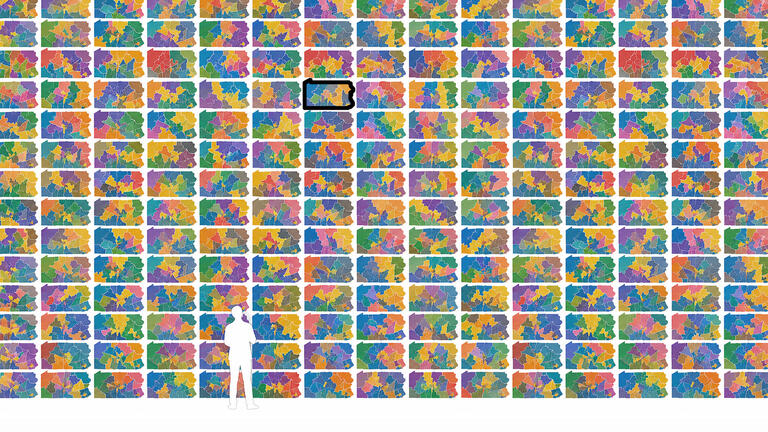
For years, these organizations have used mathematical metrics to argue in court that a given map has been gerrymandered. Veomett and her students have been testing those metrics — and using AI tools such as Markov chains to build and analyze redistricting maps across the country. The Redistricting Data Hub, whose stakeholders include the ACLU, the NAACP Legal Defense Fund, and the Southern Poverty Law Center, has asked Veomett to share her findings with them, so that the next time these organizations go to court to fight a gerrymandered map, they go in with stronger evidence.
Back on campus, Veomett and her students are cleaning and organizing redistricting data for every state. Researchers across the country are using that data to study gerrymandering and redistricting.
When Lisa Jurca ’25 MS ’27 took Veomett’s AI for Redistricting class during her junior year, she wasn’t sure what redistricting was. “I knew it had something to do with voting and that it was important, but I couldn’t see what AI and computer science had to do with it,” she says. “Now I see it has everything to do with it.”
Teaching Lawyers What AI Can't Do
Nicole Phillips wants her law students to use AI. She also wants them to know when not to.
Phillips is an associate professor of legal writing in the School of Law, and last year, USF became the first law school in the country to embed generative AI into its required first-year curriculum. Every student who wants a JD from USF now has to grapple with AI — not as an elective, but as a fundamental part of law. “AI isn’t a separate skill,” she says. “It’s how lawyers work today.”
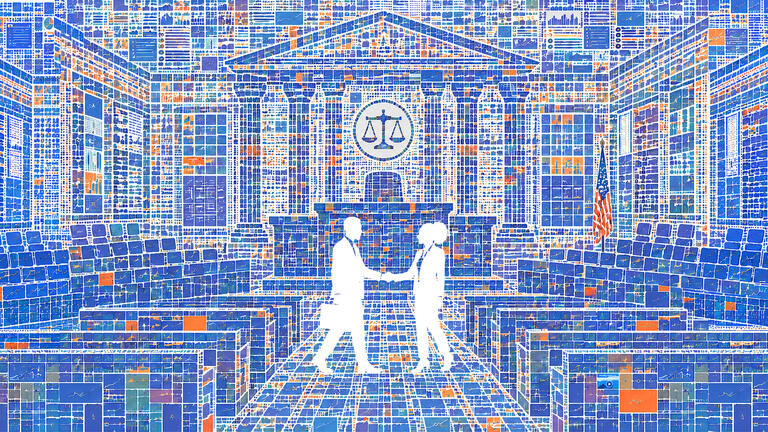
She says that in her legal writing course, students spend the first part of the semester learning to research and write without AI, so that when they do start using the tools, they can tell whether the tools are doing the job well. “If the students themselves don’t understand it, how can they even check?”
The profession is changing fast, she says. AI is taking the job of the first-year associate — the young lawyer buried in depositions and medical records. “Our new graduates are actually going to be supervisors,” she says. “They get to do some of the more fun things in law.”
The fun things, she says, are the human things. Phillips practices employment law, which she says is the story of people: a boss and an employee, and something went sideways. “AI can read a document, but it can’t take a deposition. It can’t read a client and know that all they really want is an apology.”
Beyond the classroom, the law school’s CREATE Clinic (Creative Rights, Entrepreneurship, Access, Technology, and Enterprise) takes its work into the community. Professor Jessica Fajfar and her students do legal work for artists, musicians, entrepreneurs, and small businesspeople. “They’re confused, they’re getting displaced, they’re trying to understand what AI means,” Fajfar says. She and her students work with organizations including Berkeley Art Center, Precita Eyes, the Faight, and ArtSeed to help their constituents know their rights, register their works, and take action when someone infringes on them.
“AI can read a document, but it can’t take a deposition. It can’t read a client and know that all they really want is an apology.”
One current client is AI:OK, a music industry initiative building a trustmark — a certification signaling that a piece of music was primarily human-made and that artists whose work was used to train AI models have been fairly compensated. USF law students are helping protect that mark in the United States.
Building Apps for the Common Good
Hannah Martin ’29 didn’t think she could build an app. She’s an environmental science major, not a computer scientist. “I was like, I don’t know how to code,” she says. “But then it probably took me 20 minutes to start an app because the professors explained it so well.”
Martin is one of 115 first-year students in USF’s Horizon Collective, a new program that brings students from 13 majors together to work on real-world problems at the crossroads of sustainability, health, and technology. “That’s where the world’s biggest challenges are — and where the opportunities are,” says Saralyn Ruff, associate professor of psychology and faculty director of the Horizon Collective.
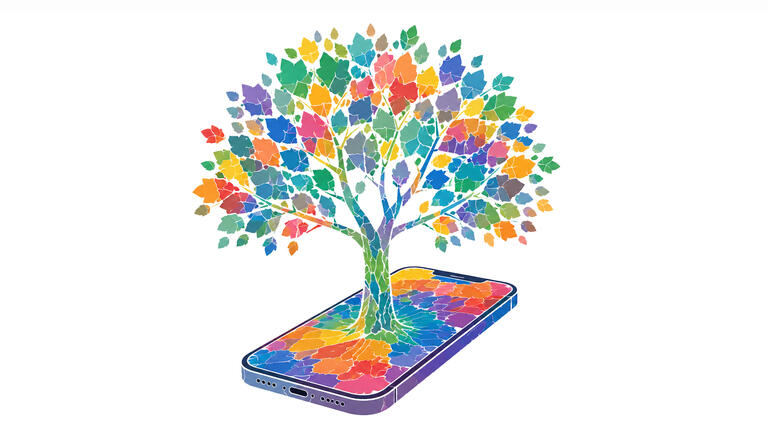
As part of the program, Horizon students use AI tools to build wellness apps. Martin built an appreciate-nature app. Open the camera, point it at a plant or a tree, and the app identifies it. “We know that as a society we’ve shifted away from nature,” she says. “When you walk outside and interact with plants, serotonin and dopamine are released in your brain. My app encourages you to do that.”
Enia Guerra ’29, a computer science major, built a workout tracker. “When you press start, it asks you what kind of workout you're doing and then it asks how you're feeling in that moment. And then after you finish your workout, the app again asks you how you feel,” she says. “It helps to see your good feeling represented visually on your phone: seeing is believing. When you can actually chart your happiness, you’re more likely to make exercise a habit.”
Guerra said she joined the Horizon Collective because it inspires her to take action. “What intrigued me in particular was the intersection of AI and climate change and being able to tackle issues that go with that, because I want to use my computer science major to help the world, and I know that AI doesn’t help the climate at all.”
Reed Johnston ’29, a psychology major who minors in film, built a website aimed at parents of children under 12, raising awareness of consumerist, dangerous, or violent videos that children encounter every day on YouTube and YouTube Kids. The site links to websites that Johnston describes as safe, educational, and affordable, with an eye toward lower-income households, where he says screen time tends to be highest.
Johnston assembled the site using an AI tool that builds websites and mobile apps from plain-language prompts, no coding required. He also created a short video and placed it on the homepage. The video opens with footage from a Logan Paul post showing a suicide in a Japanese forest, and closes with Mr. Rogers testifying before Congress on the importance of children’s programming.
“I was very strongly anti-AI before this project because I hadn’t seen it used in a helpful way yet,” Johnston says. “This was a rare case where I actually saw the benefits.”
Writing the Book on AI and Journalism
USF grad Yumi Wilson MFA ’07 teaches journalism at San Francisco State. She is also watching AI remake everything she teaches.
Wilson is writing a textbook on journalism in the age of AI — about how to use AI tools, she says, without losing creativity, curiosity, or ethics. By the time the book hits shelves next year, some of it will be out of date, so she emphasizes larger, more enduring things: “truth, integrity, critical thinking, and what readers can and cannot trust.”
Wilson’s reckoning with AI began when a student whose writing had been a struggle all semester turned in an opening paragraph that was, she says, “just amazing.” A friend suggested the student had probably used AI. Wilson hadn’t even considered the possibility. “I had fallen behind,” she says.
In one section of her book she addresses what she calls “zero clicks.” In the past, when someone searched Google for breaking news, Google returned a list of results, and users would click through to the New York Times, the San Francisco Chronicle, or other outlets. That click-through traffic was a prime source of revenue for news sites.
Since Google added AI overviews to its search results, click-through rates have plummeted, Wilson says. “Users now get a synthesized answer on the search page and don’t navigate to the underlying source.”
For newsrooms, those lost clicks mean lost revenue. In early February, the Washington Post laid off 30 percent of its staff — and, like many publications, it’s exploring AI-driven technology for content workflows, podcasts, and aggregation. If newsrooms are using AI to produce content, Wilson asks, what does that mean for human journalists?
As a professor of journalism and the host of “The Journalist’s Guide to AI” podcast, she says she owes it to her students to understand how AI is reshaping the field. “I can’t sit this out.”