They Went Forth
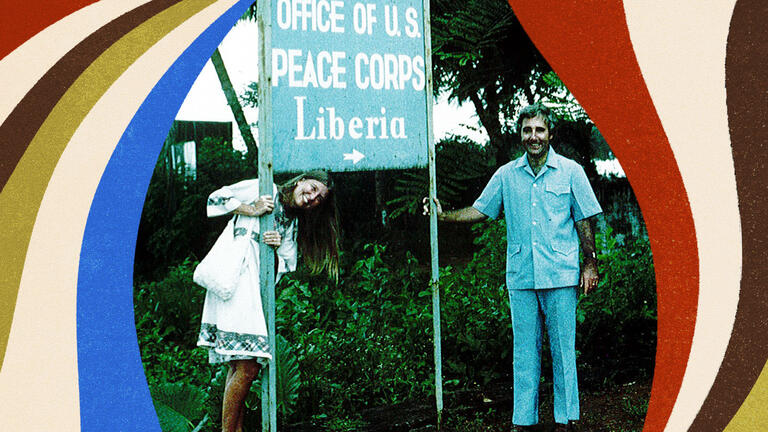
Pam and Dennis Lucey arrive in Liberia for his Peace Corps assignment as country director
In 1961, John F. Kennedy called on Americans to learn a language, leave home, and serve abroad. Since then, 377 Dons have said yes to the Peace Corps. Meet five of them.
Sent by Special Request
Dennis Lucey ’61, Recife, Brazil and Liberia, West Africa
In 1963, Dennis Lucey boarded a Greyhound bus with a one-way ticket from San Francisco to Washington, D.C. "The energy there at that time was palpable," he says. "You could hit the streets and walk into the Washington Post and get a job."

That’s what Lucey did. A former sports editor of the San Francisco Foghorn, he covered high school sports for the Post on weekends and worked during the week for the Burroughs Corporation, a competitor of IBM. Xerox lured him away to a management position in its federal division. Then, through a corporate service program, Lucey says Xerox loaned him to the Peace Corps, where he was put in charge of a hospital ship.
The SS Hope was anchored off the coast of Recife, Brazil, and served as a training hospital for medical workers from around the world. Lucey called the 500-person staff together on his first day. “I told them, ‘I've never been in a hospital since the day I was born.’”
He ran the ship for a year. The Peace Corps then called Xerox and asked for two more years of his time. He went to Africa and ran the Peace Corps in Liberia.
“The Peace Corps brought meaning into my life at a time when I needed it most,” Lucey says.
Lucey was back in Washington on a break when his cousin told him there was someone he should meet. "Pam came up to me and her first words were, 'I want to go to Africa.' I told her, I'm here for 21 days — we'd better get married, quick. So we did. And we’ve been together ever since."

She Went to Teach. He Came to Lunch.
Evelyn Kohl LaTorre EdD ’83, Abancay, Peru
Evelyn Kohl LaTorre grew up in rural Montana and moved to California as a teen. “My eyes opened up to the world. From then on, I always had an interest in other cultures and different ways of life.”

In 1964, the Peace Corps assigned her to the schools of Abancay, a town in the Andes Mountains in Peru. For the two years, she taught physical education, sewing, baking, and cooking to the girls of the community.
During her time in Abancay, LaTorre would regularly enjoy lunches at the home of the Egiluz family. One day, their stepson, Walter — a student at the Universidad de Cusco — joined them. About a year later, Walter LaTorre and Evelyn were married in a Spanish chapel behind the Cusco Cathedral.
The LaTorres moved to California, not far from her family. Evelyn raised their sons, worked full time, took classes on Saturdays, and earned a doctorate from USF in 1983.
“The new multicultural education doctorate was a perfect match for me. I kept working full time while taking classes on Saturdays. The faculty came from a variety of countries and was superb. In just three years I had my degree.”
She went on to write two books, Between Inca Walls, A Peace Corps Memoir, and Love in Any Language, A Memoir of a Cross-Cultural Marriage.
In June, the LaTorres mark their 60th wedding anniversary.
She Taught Through Stories
Valarie Duran ’07, Kičevo, Macedonia

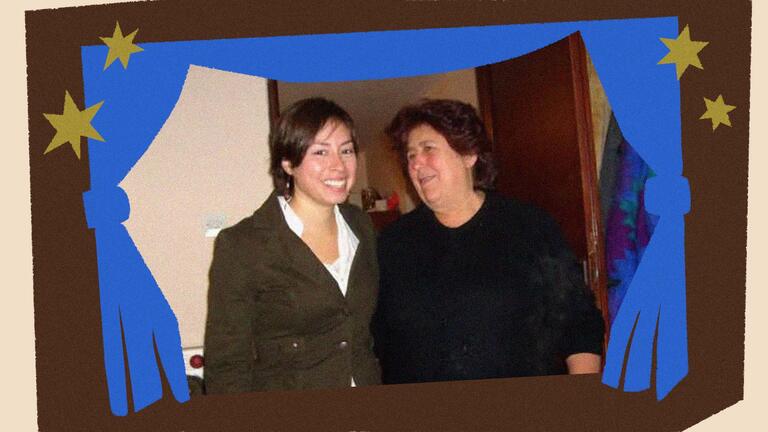
Valarie Duran discovered the Peace Corps by accident. “I was meeting with my Latin American studies professor, and I saw a flyer for the Peace Corps on a bulletin board outside her office,” she says. “I remember the flyer said, ‘Life is Calling … How Far Will You Go,’ and listed a bunch of interests and qualities the right candidate would have. I identified with all of them.”
Duran had worked as an America Reads tutor through USF’s Engage San Francisco Literacy Program and had heard that the Peace Corps needed English teachers to teach children. The only catch? The need wasn’t in Latin America, which was Duran’s first choice for placement. It was in Eastern Europe, a location she knew nothing about. “I had to process that — as the first person in my family to ever travel for a job, going halfway around the world to a country I’d barely heard of was daunting. But I knew this was my chance — to travel with purpose, to follow my curiosity, to teach children — so I took it,” says Duran.
In 2007, Duran arrived in Macedonia (now known as North Macedonia) with the Peace Corps. There, she was able to realize her dreams of both teaching children and storytelling. She created a screenwriting class, produced a play in English that the kids performed, and made a short film in English with the class. During her breaks, Duran visited Turkey, Bosnia, Croatia, Hungary, and Montenegro.
“I realized how big the world is, and how much more I wanted to explore of it.”

I had to process that — as the first person in my family to ever travel for a job, going halfway around the world to a country I’d barely heard of was daunting. But I knew this was my chance — to travel with purpose, to follow my curiosity, to teach children — so I took it.”
Valarie Duran ’07

They Ran the Business. He Built the Books.
Kai Thompson ’16, Huashao, Peru
Kai Thompson was familiar with the Peace Corps since childhood — his friend’s parents had met in the program. The accounting major from Lakewood, Colorado, always had it in the back of his mind, through high school and during his time at USF.

After a one-year stint at Price WaterhouseCoopers, he realized it was time to turn the idea into a reality.
“I had this feeling like I needed to be doing something more than helping big corporations pay less in taxes,” Thompson says.
In 2018, Thompson was assigned by the Peace Corps to Peru, where he lived in a small village at the edge of Huascarán National Park, near the base of the nation’s tallest mountain. There, he worked with a community that operated a boat tour and restaurant business, staffed by single mothers.
“There was no accounting system at all,” he says, “They were losing out on revenue because they had no way to keep track of what they earned.”
Thompson developed a paper accounting system that enabled the women to prepare for how many people to expect, and how much food to order, by allowing them to look over past sales.
After his time in the Peace Corps was cut short in 2020 due to COVID-19, Thompson attended law school at the University of Chicago and returned to Colorado to join a litigation firm. His most recent case: prisoners’ rights.

She Coached Soccer and Taught Bookkeeping
Lilly Ryan ’21, Colombian Coast
Lilly Ryan is a business management major who joined the Peace Corps in 2025 and used her USF degree to support economic development in rural Colombia.
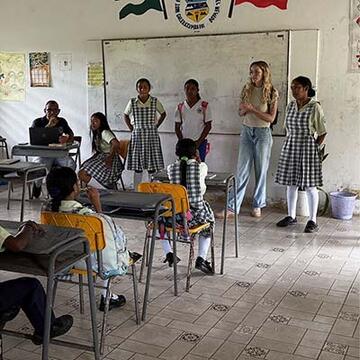
“Our three objectives when working in economic development are to improve the livelihoods of the people we serve, teach skills that you learned in your own country, and work with the area’s children to increase the opportunities they’ll have later in life,” says Ryan.
In the village where she lived with a host family, Ryan taught children about entrepreneurship, worked alongside business owners to improve bookkeeping and sales, and volunteered with the community to improve financial literacy in general.
“It’s so rewarding working with young girls and opening their eyes to what a different future might look like,” says Ryan, who helped coach a girls’ soccer team in town and guided young women in a club designed to provide leadership skills to girls who are setting their sights beyond traditional roles for women.
Ryan aspires to complete a master’s degree in international development or peace studies. “I love the structure of the Peace Corps program, as well as the opportunities it provides and the reputation it has in the international service community. I’m so grateful … and so excited for the future.”
I love the structure of the Peace Corps program, as well as the opportunities it provides and the reputation it has in the international service community. I’m so grateful … and so excited for the future.”
Lilly Ryan ’21