December 3, 2026-February 14, 2027
What We Carry
Artists: Al-An deSouza, Angela Hennessy, Stephanie Syjuco, Rupy C. Tut, and Maryam Yousif
What We Carry presents work by five Bay Area artists working in media from video and digital prints to hair, sound, clay and handmade pigment on paper. Yet each of them takes inherited ideas and stories, from the culture around them or from their own families, and reworks their meaning.
Featuring process materials, some never shown in public before, the exhibition explores how these artists turn ideas about inheritance into form, and the particular kinds of intelligence and labor that work requires: activating memory, refusing terms set down by others, and testing imaginative possibilities. What the artists carry in their minds and hearts becomes the objects we see.
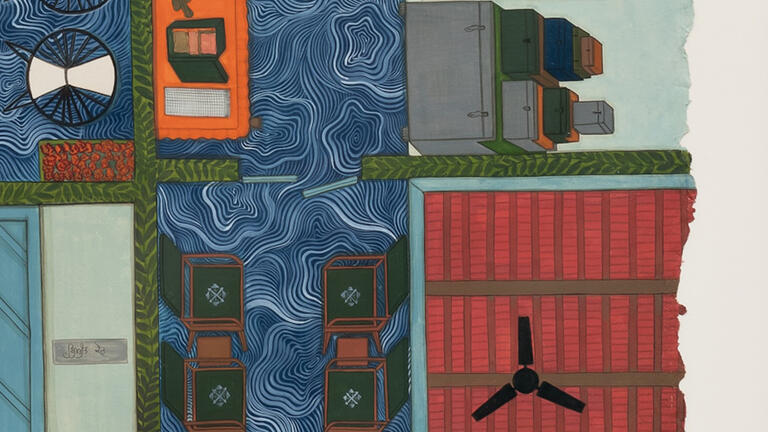
Stephanie Syjuco's videos of archival photographs refuse the colonial gaze and uncover a community history of self-determination. Al-An deSouza reorients the London Underground map, overwriting its stations with the names of people who shaped them: artists, activists, and people killed by police and in racist and anti-trans attacks. Angela Hennessy weaves synthetic hair into funerary displays and offers a sound work that reflects on the exhibition’s theme. Maryam Yousif rebuilds and remixes personal memories, Iraqi modernism, and ancient Mesopotamian forms in clay. Rupy C. Tut paints the same house twice in hand-ground pigment, as her grandmother knew it, and as she herself has seen it since.
The works on display transmute loss and grief, both long past and ongoing, and leave us to decide what to remember, refuse, keep, rework, let go or carry forward.
The Artists
Al-An deSouza (b. 1958) is a trans-media artist who activates multiple inheritances, drawing on cultural influences, family history, and colonial legacies that span the globe. For deSouza, each work decides its own form, and their practice moves between photography, performance and writing, among other media. They often create fictions that shed new light on the colonial record, including altered photographs, doubled texts, and documentation of imagined expeditions. Their work gives material form to what they describe as the complex, alchemical process of being a thinking person moving through the world, and to an invisible network of social relations, of which the viewer is a crucial part.
Angela Hennessy (b. 1971) is an interdisciplinary artist and a self-described grief keeper. A survivor of gun violence, she explores practices of mourning and how the living are responsible to the dead. Her use of synthetic hair references and venerates the material's importance in Black culture and her practice transforms repeated actions usually considered domestic labor, such as braiding, crocheting, washing, stretching, and wrapping, into ritual gestures. Hennessy's mourning objects force the viewer to face our society's discomfort with death and collective Black grief. Her work opens space for discussions about the dead, how grief impacts life, and how we might pay close attention at the threshold, to the body and to the spirit, and to each other.
Stephanie Syjuco began as a sculptor, and in her subsequent work across photography, digital video, and installation she continues to foreground the physical presence of objects. Her recent work goes into archives: first colonial records, showing how images in official narratives contribute to forms of exclusion, and then collections that communities built for themselves because no institution had included them. Syjuco photographs, blurs, blocks and re-stages what she finds, treating the archive not as a closed historical space but as an active one. She asks what is being remembered now, and what is being taken away, reframing it all to remind us that the past is still unfinished business.
Rupy C. Tut (b. 1985) grinds her own pigments, prepares her own hemp paper and linen, and paints in a traditional eighteenth-century Indian style to create artworks about her position in and perspective of the world. A descendant of Partition refugees and a first-generation immigrant, she took up a form of painting that had excluded women in order to rewrite its history. By infusing culturally specific materials and techniques with deep personal meaning, she expands and complicates narratives of displacement, belonging, and gender. Tut invites the viewer to stand both as witness to and as co-author of a story that joins the past, present, and future.
Maryam Yousif (b. 1985) is a ceramicist who draws inspiration from artistic traditions ranging from ancient Mesopotamian to Iraqi modernist to Bay Area funk. Working in clay, a medium that she finds forgiving and mysterious, has become an extension of how she thinks. Yousif often begins with a story, whether from personal memory, a museum's archive, or contemporary popular culture. She then transforms and remixes images and icons, bringing together diverse cultural forms to create new mythologies. Her work questions what it means to leave a homeland behind, what one might take with them, and what future ruins we might make.
Curatorial Team
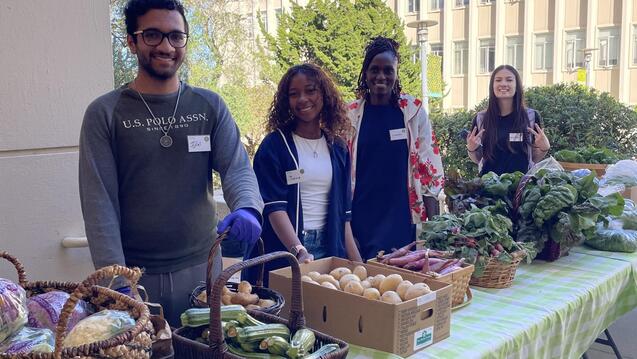
What We Carry is curated by graduate students in the Curatorial Studies Practicum in the Museum Studies MA at the University of San Francisco led by instructor and guest curator Deena Chalabi, in collaboration with the Thacher Gallery.
Content: Alyssa Camarillo (‘26), Cali Dorsch (‘27), Sydney Livingston (‘26), Haley Wells (‘27)
Design: Dest Acevedo Buendia (‘27), Montserrat Bracamonte Sierra (‘27), Katharine Smith (‘27), Devan Vane (‘26)
Visitor Experience: Gabriela Arteaga-Lara (‘26), Nina George (‘26), Sabrina Marcone (‘27), Skyla Loffland (‘27)