Alumni
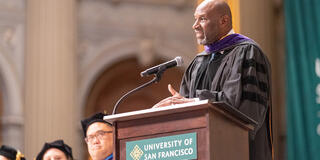
Nearly five decades after graduating from USF Law, retired California Supreme Court Justice Martin Jenkins ‘80 returned to the Hilltop to deliver the law school’s 2026 commencement address: A full-circle moment for one of USF Law’s most distinguished alumni.
Jenkins, who retired from the Supreme Court of California earlier this year, told graduates that attending USF Law was “one of the most important decisions of my life,” crediting the school with shaping his career. “The legal education I received here was second to none,” he said. “It was truly a transformative experience.”
The son of parents who came to San Francisco seeking opportunity and dignity after growing up under segregation in Texas and Louisiana, Jenkins spoke candidly about the values that guided his life and career: integrity, humility, civility, mentorship, and service to others. He urged graduates to embrace honest self-evaluation, seek out mentors, and use their legal education “not only to build a successful career, but to expand justice and create opportunities for others.”
The themes reflected a career defined by public service and judicial leadership. Over more than four decades, Jenkins served as a state and federal trial judge, a justice on the California Court of Appeal, Judicial Appointments Secretary to Governor Gavin Newsom, and ultimately as an associate justice of the California Supreme Court. Earlier in his career, he prosecuted civil rights cases for the U.S. Department of Justice, including cases involving Ku Klux Klan violence in the South.
Widely respected for his thoughtful jurisprudence and steady courtroom demeanor, Jenkins became the first openly gay justice on the California Supreme Court and only the third Black man to serve on the state’s high court. Throughout his career, he remained deeply connected to USF Law, mentoring generations of students and alumni and serving as a trustee emeritus of the university.
In his introduction at commencement, longtime friend and fellow USF Law alumnus George Leal ‘80 described Jenkins as “the living embodiment” of the principle that “our character is our destiny.” He praised Jenkins’ compassion, work ethic, and lifelong commitment to ethics and civility in the profession.
For the graduates seated before him, Jenkins framed the law not as a path to status, but as a vehicle for service. Quoting Langston Hughes and reflecting on the enduring promise of justice, he reminded the Class of 2026 that “the law is a profoundly human enterprise” and urged them to carry that responsibility forward with courage and integrity.