“Not Just Words on a Page”: Race, Power, and the Limits of the Law
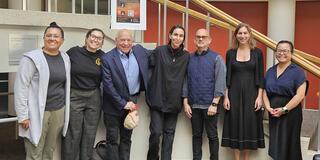
Behind every appellate opinion is a person whose life was shaped by the outcome. That theme anchored “Whose Justice? Storytelling, Power and the Limits of the Law,” the October 19 event hosted by USF’s Racial Justice Clinic.
Award-winning journalists Rick Tulsky and Justine van der Leun joined alumnus David Weiss ‘90, a partner at Reed Smith, in a standing-room only event attended by law students, alumni, and other community members. Tulsky and Van der Leun’s new books explore how race, gender, and power shape whose stories are believed and how justice is administered.
“What you’re learning in law school can seem a little bit divorced from the actual people who are involved when they get reduced to an appellate opinion,” said Professor Lara Bazelon, Director of the Racial Justice Clinic. Long-form journalism restores that humanity, she explained, allowing the people at the center of these cases to “emerge as fully formed human beings, and not just words on a page.”
Both authors have done exactly that. In Injustice Town, Tulsky tells the story of Lamont McIntyre, who spent 23 years in Kansas prisons for a double murder he didn’t commit. Tulsky says the case involved a corrupt police officer and a corrupt prosecutor. It also involved a defense lawyer later disbarred and a judge who hid an affair with the prosecutor. Freedom brought its own struggle. “Rick, I don’t know how to be a man,” McIntyre told him after his release at 41. “I’m still 17 years old.”
Van der Leun’s Unreasonable Womenexamines criminalized survival, the prosecution of people, usually women and girls, for actions they took to survive violence. To measure its scope, she wrote to some 10,000 incarcerated women. Their roughly 1,000 responses suggest that at least 30 percent of women imprisoned for murder or manslaughter are criminalized survivors. Many of the women she writes about were ignored as victims, then disbelieved as defendants. To secure long sentences, she said, prosecutors had to erase the abuse that shaped their lives. “No person is an abstraction,” she said.
Both authors made clear that these outcomes are not random. “If you are not one of the people with power in society, the system doesn’t work the same for you as it does for others,” Tulsky said. Van der Leun described how one woman in her book, a poor Black mother from Saginaw, Michigan, was treated by prosecutors as expendable. “She was considered disposable,” she said.
Weiss has seen these failures up close. He was a point lawyer on Reed Smith’s investigation into the Oklahoma death penalty case of Richard Glossip, whose conviction the U.S. Supreme Court later vacated. He also does extensive pro bono work, including with the Racial Justice Clinic.
For Tulsky, the lesson for future lawyers comes down to persistence. “If you fight for somebody, if you believe in their case and don’t give up, and are persistent, you can at least accomplish justice in an individual case,” he said.
At USF, students are already doing that work. When Tulsky first proposed the event, Bazelon and her clinic students were litigating a wrongful conviction case in Pennsylvania. Tulsky flew out to attend the hearing and meet their client.
Bazelon closed the evening with a message for the students in the room. “Change is possible, and it’s your generation that is going to do more, and do better, and do right.”