For the Planet, For Her Students
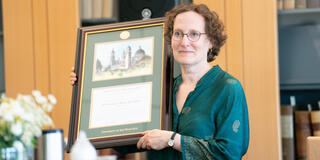
“I'll miss the community, the smiles in the hall, the 'how's your day', and the 'thank yous' our students relay so generously.” For Professor Alice Kaswan, reflecting on 27 years at USF Law, it's the people who stand out above all else.
“The students, the faculty, and the staff bring such positive energy to their engagement with USF,” she said. It's a reflection that tells you everything about who she is.
This summer, after nearly three decades of teaching, scholarship, and advocacy, Kaswan retired from USF Law, where she had become the school's most recognized voice in environmental justice and climate change policy.
A Career Built with Purpose
Kaswan arrived at USF in 1999 as an associate professor, but her path here was deliberate from the start. While clerking for Justice Marie Garibaldi on the New Jersey Supreme Court and honing her practice at Berle, Kass & Case and Morgan, Lewis & Bockius, she never lost sight of where she was headed. Teaching had always been the goal; a calling, not just a career. After four years on the faculty at the Catholic University School of Law, she found her home in San Francisco.
Over the next 27 years, she became a Dean's Circle Scholar, served as Associate Dean for Faculty Scholarship, and stewarded the ELSAS (the Environmental Law Student Alumni Society). For the last few years, she has also co-chaired USF's One Earth Initiative, the university's effort to integrate environmental justice and sustainability across the institution as called for by Pope Francis's landmark encyclical Laudato Si': On Care for Our Common Home.
At the Intersection of Climate and Justice
Since the mid-2000s, Kaswan's scholarly work has focused on climate change and environmental justice. “I always wanted to do something to change the world from here and better the planet,” she said, “especially as climate change emerged as one of the paramount concerns of our lifetimes, and of the lifetimes of future generations.”
Kaswan has seen interest in environmental justice go through ebbs and flows. “When I started teaching in the mid-90s, it was on an upswing as people began recognizing that the panoply of environmental laws that had been adopted in the 1970s were not adequately addressing disproportionate pollution burdens in marginalized communities.” She notes that these years were followed by relative stagnation and credits the Biden administration with later bringing an “unprecedented level of attention to environmental justice.” While Kaswan acknowledges that the Biden-era policies have since been reversed, she believes that “the movement has become more powerful and more organized” over the last few decades.
Building Bridges Between Students and Alumni
One of Kaswan's most enduring contributions is the way she has helped build connections between students and USF Law graduates.
Around 2013, she and then-student Michael Hewitt ’15 reimagined the Environmental Law Society, expanding membership to include both students and alumni. The organization remains active today, bringing together current students with the practitioners who were once in their shoes. “ELSAS has allowed me to maintain relationships with alumni in the field, making it a lot easier to connect current students with alumni mentors,” Kaswan said.
That ongoing connection with alumni is something former students feel deeply. Leuwam Tesfai ’12, now Executive Director at the California Public Utilities Commission, has stayed connected through ELSAS. “I am very grateful for Professor Kaswan's mentorship. Working as her research assistant during law school exposed me to climate adaptation and environmental justice, issues that continue to play a role in my career.”
For Kaswan, that kind of impact is a measure of a life in teaching. “As a teacher, I'm proud to vicariously live through my students' accomplishments. As a scholar, I've spent decades writing about environmental justice and climate justice that I hope will help shape the field. The life of a professor has multiple dimensions, and I feel lucky to have found all of them meaningful.”