Equipped to Lead and Succeed
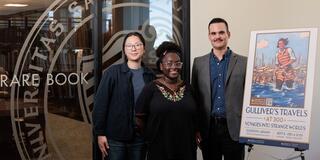
Joyce Chu ’26 was looking for an internship. Then she spotted an email to English majors from a professor seeking students to help with an exhibition. “It almost felt like that email was sent out just for me.”
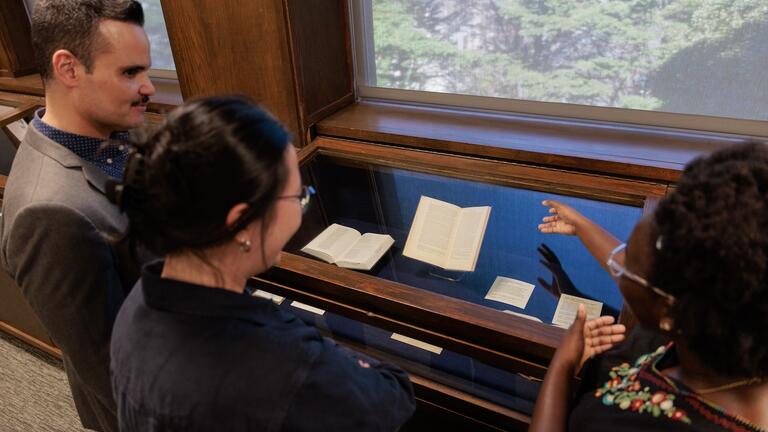
Chu responded and joined the project. Today, she and fellow English major Amira Walker ’27 are curators of “Gulliver’s Travels at 300: Voyages Into Strange Worlds” in Gleeson Library under the guidance of Omar Miranda, the professor of English who sent the email.
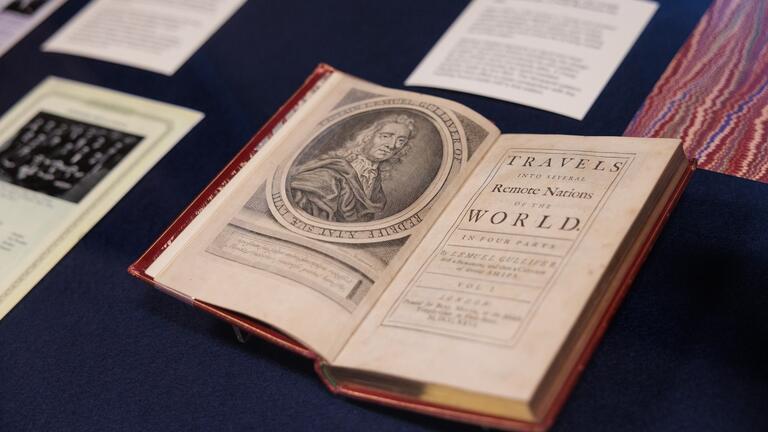
At the heart of the exhibition is USF’s own first edition of Jonathan Swift’s novel, published in 1726 and donated to the university in 1989 by Charles Albert Shumate, Class of 1927.
“Exactly 300 years after the book first appeared, USF has brought it out of the archives and built a show around it,” Miranda said.
“At first, it was going to be an exhibition about rare books in the library, but Joyce and I made it about one book: Gulliver’s Travels,” Walker said.
“They convinced me!” Miranda said. “I had envisioned an exhibition for the tricentenary for years, but Joyce and Amira persuaded me to focus the display entirely on Gulliver’s Travels rather than a broader selection of our most rare books.”
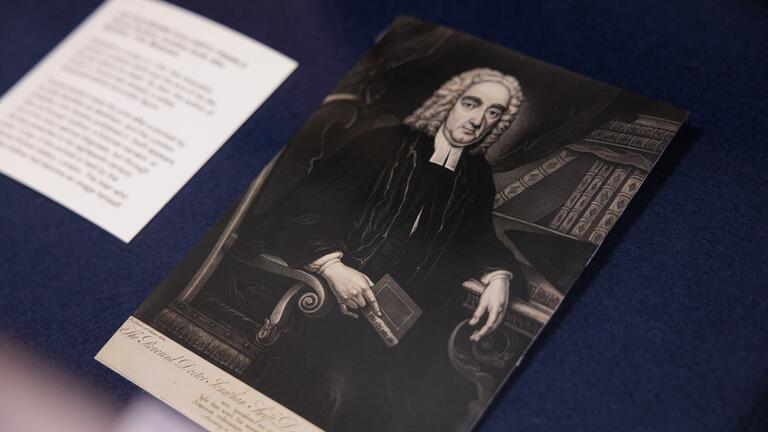
For six months, Chu and Walker explored the library’s stacks and examined materials in the Donohue Rare Book Room, working with Miranda and with John Hawk, head of special collections, to determine which books and images would go into the exhibition.
“We found our own rabbit holes,” Walker said. “For Joyce, it was the circus. For me, it was politics and satire.”
Chu’s interest in the circus started with Gulliver’s Travels, she said. “In the book, a giant puts miniature Gulliver on show for money. It got me thinking about circuses and circus performers whose unusual bodies are used as public attractions.” She chose The Circus Book, a history of the circus by Rupert Croft-Cooke, to include in the display.
In the end, Chu and Walker selected enough material to fill 10 display cases, organized around Gulliver’s four voyages: to Lilliput, where the people are tiny; to Brobdingnag, where they are giants; to Laputa, a floating island inhabited by astronomers and mathematicians; and to the land of the Houyhnhnms, where intelligent horses live among Yahoos.
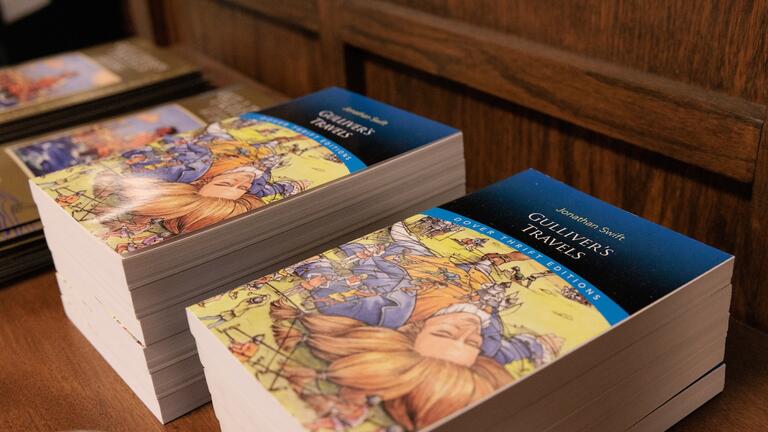
“We want visitors to feel that they’ve traveled somewhere, rather than simply look at old books in cases,” Miranda said. “The whole point is that Gulliver’s Travels is 300 years old but it’s still fresh: politics, science, gender, travel, and what it means to be human. Those questions feel alive in 2026.”
In their work on the project, Chu and Walker “went well beyond the close reading and critical thinking we emphasize in our classes,” Miranda said. “They conducted archival research, developed their own curatorial vision, and learned how to turn literary scholarship into a public exhibition.”
They also discovered abilities and interests they didn’t know they had.
“Before I did this project, I hadn’t done any marketing or design to speak of, but the poster, brochure, buttons, bookmarks, and signs that you see on the exhibit? I designed those,” Chu said.
“Before I did this project, I thought I wanted to be a lawyer. Now I want to be a librarian!” Walker said.
“Gulliver’s Travels at 300: Voyages Into Strange Worlds” runs Monday through Friday, 9 a.m. to 5 p.m., through Dec. 4 in the Donohue Rare Book Room on the third floor of Gleeson Library.