Equipped to Lead and Succeed
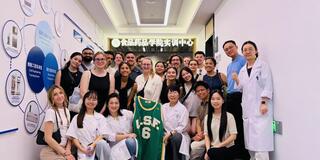
Reading about China’s biotechnology industry is very different from “going in person and talking to someone who’s doing the research,” Audrey Guan MS ’26 said.
Guan is one of 21 students from the Biotechnology Professional Science Master’s (PSM) program who spent a week in May in Hong Kong, Shenzhen, and Beijing as part of an Academic Global Immersion class. Led by program co-director Cary Lai and administrative director Luwei Xie, the class trip included visits to companies including Beijing Naton Medical Group and the Shenzhen Institutes of Advanced Technology, and to universities such as the Chinese University of Hong Kong, Shenzhen.
Guan said the PSM program chose China for this year’s immersion because the biotech industry there is “growing very fast.”
At the Industrial Innovation Center of Engineering Biology in Shenzhen, Aaron Moranville MS ’26 saw what he called “islands” of instruments: one with top foreign equipment, another with domestic. The researchers there said they want to make domestic equipment that is equal to the best equipment from abroad, to be “self-reliant as a biotech community within China,” he said.
At Guangming Science City, the students toured “a completely autonomous lab, where robotic arms work at lab benches and move on their own, filling pipettes and running experiments,” Sierra Donn MS ’26 said. “This is something I had never seen before.”
Moranville said that because he and other biotech researchers aim to improve patients’ lives, he sees China less as a threat than as “an opportunity to see the perspectives and research and innovation of another country.”
Donn agreed. “Yes, you could see China as competition in the biotech field, but at the end of the day, I care more about finding solutions to medical problems,” she said. “I think it makes sense to see China as a potential collaborator or partner, or at least have conversations with different people there to see what they’re doing.”
Beyond classrooms and laboratories, the students visited sites like Tiananmen Square, the Temple of Heaven, and the Great Wall. Moranville said the students got to “immerse into the culture there.” Guan said tour guides explained Chinese history on the rides between sites. “We had a lot of fun,” she said. “We all bonded.”
Guan, Moranville, and Donn now work in biotech in the Bay Area. Guan does protein research at Centivax, a drug development company in South San Francisco. Moranville does drug discovery research at Nurix Therapeutics in Brisbane. Donn works in operations at HelloBiome, a startup in San Francisco that tests how health and beauty products affect the bacteria living on human skin.
Moranville called the immersion trip to China “one of the highlights of the entire two-year program.”
Donn went further. “When I heard about this class and its trip to China, I had to do it. I mean, even if I went to China on my own, I wouldn’t be able to tour the companies we went to or visit the universities we visited and meet with professors and students. It was a once-in-a-lifetime experience.”