San Francisco Advantage
Kathryn Clarke-Garcia ’26 talks about woodblock prints, lantern slides, and her path from San Francisco to Washington, D.C.
What are you up to this summer?
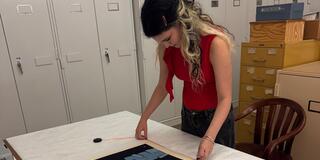
I’m an archives and collections intern at the National Museum of Asian Art, which is part of the Smithsonian Institution. I’m reviewing seals on a collection of Japanese woodblock prints, making sure the publisher information for each print is correct in the museum’s database. I just took a modern Japanese art class, so I’m excited to be working with woodblock prints. I’m also working with lantern slides, which are glass plates with photographic images on them. I’m organizing them and helping to preserve and protect them.
How did you find this position?
I found it on a job-listing board called the American Alliance of Museums. Professor Karen Fraser, who taught my internship course, recommended it. She helped me understand what professional practice looks like.
Have you worked in museums before?
Yes. I first worked as a peer docent and gallery assistant at Thacher Gallery at USF. From there, I interned at the Cartoon Art Museum in San Francisco, and then last summer I interned at the California State Railroad Museum in Sacramento. At the railroad museum, I worked really closely with archives and collections people because I was pulling historical photographs of the trains, and I was also learning how to write for interpretation. Being able to apply those skills from earlier internships and talk about them with confidence in the Smithsonian application helped me a lot.
Tell us about the museum studies program at USF.
Museum studies isn’t a typical undergraduate program. Typically, you’re going to get art history, which is more theory-based. I got that at USF, but I also got professional practice. With Professor Catherine Lusheck, we took Methods and Theories, a course about the methods you use both to analyze things critically from an art historical perspective and to understand how other art historians critique artwork. In that course, we also put on a show in the Rare Book Room in Gleeson Library. That was my first time ever writing for exhibition. When I interned at the railroad museum, I already had those skills, which was very helpful.
What are your plans after the internship?
I’ve started looking at full-time positions. I think down the line I want to pursue more education, whether that’s getting a master’s degree in museum studies or possibly going into curation, which would lead me to getting a PhD. I’m not sure about that yet. My goal for now is to keep working in museums.
What’s your career advice to students starting college?
I’ve noticed that people really respond to enthusiasm. Because everything in the working world is so uncertain, my advice is to choose a field where you’re going to be excited. Also, people want to work with people who are good collaborators. I’m lucky that I’ve chosen a career that’s really collaborative. And ask a lot of questions! I was afraid to ask questions because I didn’t want to pester people. But every professor, supervisor, and volunteer coordinator that I’ve had has been very kind with their time, and asking as many questions as possible has been so helpful.