Equipped to Lead and Succeed

Magdalena Macias kept telling herself one thing while she was applying to medical schools: all it takes is one yes.
This spring, she heard yes from seven of them.
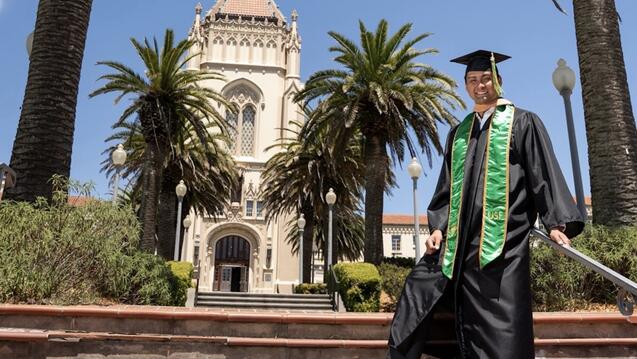
Macias, who graduated from USF in May of 2024 with a degree in biology, was accepted to seven of the eight medical schools where she interviewed, including Brown and Dartmouth. In the end she chose Johns Hopkins. She’ll start there this fall on a scholarship covering tuition and living expenses.
Macias grew up far from Johns Hopkins. She lived in Mexico until she was 8, when her family moved to Springdale, Arkansas. When it came time for college, her brother, Francisco, suggested San Francisco.
“I went to the website, took one look at Lone Mountain, and applied,” she said.
Her interest in medicine began in her early teens, when her father started showing symptoms that doctors struggled to identify, moving through bipolar disorder, depression, and Parkinson’s before landing on frontotemporal dementia in 2018. Within a few years of his diagnosis, he could no longer walk and struggled to hold conversations.
When her father was diagnosed, Macias was a high-school junior taking AP Psychology, a class that provided names and context for what was happening to him. Having language for what he was going through, she said, gave her a sense of what a doctor could do: give a family the words to understand what is happening, and walk with them through what comes next.
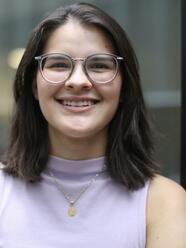
At USF, Macias connected with pre-health adviser Marie Dutton. Dutton suggested she consider work in contact-tracing. Macias found a position at the University of Arkansas for Medical Sciences, a job that put her on the phone with Latino residents in northwest Arkansas, conducting interviews in Spanish to track the spread of COVID-19 through their communities.
Dutton also pointed her toward the Amgen Scholars program, which enabled Macias to spend the summer between her sophomore and junior years at the National Institutes of Health in Bethesda, Maryland. She ended up in a neurodegeneration lab — the first time she seriously considered working on the disease that affects her father.
“I had always said that working on this disease hits too close to home, but in the lab I changed my mind,” she said. “I could really make an impact from the research side.”
In the spring of her senior year at USF, Macias took the MCAT. Her score was high, she says, but not quite what top medical schools expect. She considered retaking the test, talked it over with Dutton, and decided to let her score stand. She had other work to do.
After graduating from USF, she returned to the NIH as a post-baccalaureate researcher in dementia. She also interpreted for Spanish-speaking patients at the Kaseman Health Clinic in Maryland and traveled to Capitol Hill to speak with legislators on behalf of the Alzheimer’s Association and the Association for Frontotemporal Degeneration.
“I advocate for my dad and the 6.7 million Americans living with dementia, as well as the 11 million unpaid family caregivers who care for them,” she said.
After Johns Hopkins accepted her, a professor there told her what had made her application stand out: her clinical experience, her research, her advocacy work, and the story that connected them.
At Hopkins, Macias hopes to explore behavioral neurology, particularly young-onset dementia.
“I used to say that I wanted my work to give my father a voice, but I’ve changed it to giving his story a voice,” she said. “His voice is something he can never get back. But I hope my work can help ensure families have a voice in conversations about dementia and caregiving — that’s the big thing.”