USF Nursing Students Attend the AACN Policy Summit
Nurses receive limited formal training in policy literacy and advocacy. This gap restricts their ability to translate frontline experience and scientific evidence into meaningful policy actions that advance health equity.
As a result, the nursing perspective remains underrepresented in shaping the dialogue on healthcare reform.
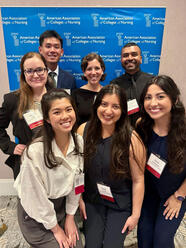
To address limited policy literacy among nurses, SONHP enables a select group of students to attend the Annual American Association of Colleges of Nursing (AACN) Policy Summit. Through this initiative, participants gain experience to serve as civic leaders in healthcare and become nursing advocacy ambassadors.
Since 2023, the dean has annually invited SONHP nursing undergraduate and graduate students to join the AACN Policy Summit, where they engage directly with federal policymakers and learn to translate scientific evidence and patient experiences into meaningful policy discussions. To ensure a well-rounded experience, the summit is paired with pre- and post-summit mentorship, fostering leadership and collaboration and empowering students to advocate for evidence-informed health policy.
By fostering participation in the Policy Summit and additional advocacy experiences, we empower nurses as science-informed advocates, strengthen healthcare systems, and ensure those closest to patient care are involved in shaping policy.
Seven USF students who attended the conference describe their takeaways from the summit:
Tina Duong, ME-MSN Student
“[A] powerful takeaway was learning how to advocate effectively in spaces like Capitol Hill. I was struck by the idea that ‘numbers numb and stories tell.’ While statistics are important, it is ultimately personal stories that create connection and urgency. This became real for me when speaking with legislative assistants. Initially, I felt intimidated, but I began to understand that my lived experiences and perspective as a nursing student carried weight.”
Sarah Peterson, DNP Student
“This experience taught me that meaningful change begins when nurses step into advocacy roles — whether at the local, state, or national level. By remaining open to growth, we as nurses can influence policies, develop essential programs, and ultimately strengthen the future of our profession and the communities we serve.”
Paul Uong, BSN Student
“If we are unable to be supported as a profession, how are we going to be able to keep our communities healthy? Our leaders are not present in the hospital at the bedside, in churches, in community clinics, in homes of families, or in rural communities of America providing nursing care. For that reason, it is why we must continue to bring these stories of our patients and community members to our leaders. It is so that they can understand that nursing care is not bound to the walls of only a hospital, but that it takes form in all aspects of our lives.”
Sarah Omar, ME-MSN Student
“I'm returning to USF energized to share what I learned and eager to build on this momentum. Another Summit attendee, Jenny, and I are exploring the possibility of starting an all-levels nursing advocacy club (BSN, MSN, DNP) to keep these conversations going. Because if there's one thing this experience taught me, it's that advocacy isn't a one-time event, it's a practice. A commitment.”
Sanjil Kumar, ME-MSN Student
“I walked away with a stronger sense of responsibility. Advocacy is not something that ends when the experience is over. It is something I plan to carry forward as I continue to grow in my role, in how I communicate, how I support patients and families, and how I contribute to improving the care environment. This experience reminded me that even small efforts matter, and that meaningful change often starts with simply being willing to speak up and stay involved.”
Sima Sadaghiani, BSN Student
“The biggest takeaway for me is that advocacy doesn’t have to be complicated. Sharing our real stories can make a difference. It can influence policy, support funding, and open doors for future nurses. Even something as simple as a conversation or a letter can create change.”
Jenny Elger, BSN Student
“What I learned is that nurses are not merely participants in healthcare systems, they are vital voices shaping them. A key insight was understanding that advocacy isn't only for experienced policymakers; it is amplified by those of us directly involved in patient care and education. As nurses and nursing students, we offer genuine, human-centered insights, and sharing these perspectives intentionally makes a significant impact.”