Equipped to Lead and Succeed
Sport is often described as a universal language, one that connects communities, cultures, and countries. But understanding how sport operates globally requires more than theory. It requires immersion.
Through the University of San Francisco’s Global Sport Management Immersion course in Australia, graduate students step beyond the classroom and into one of the world’s most dynamic sport ecosystems. While visiting organizations in the Gold Coast and Melbourne, students engaged with industry leaders, explored iconic venues, and experienced firsthand how sport intersects with culture, community, and commerce.
This course intentionally connects academic concepts to real-world application. Moving between stadium tours, conversations with league executives, and hands-on experiences, students explore how sports systems operate beyond the U.S. model. Concepts that once existed only in textbooks take shape in real environments, with real people, and have real impact.
For many, that shift is immediate. Nolan Burton ’26 noted, “Studying sports analytically through textbooks does not compare to experiencing them in person.”
Students were exposed to a different approach to the business of sports. In the U.S., sport is often defined by commercialization, media rights, sponsorships, and revenue generation. In Australia, students observed a model where sport is deeply embedded in the fabric of society, shaped by public investment, connected to community life, and aligned with broader national priorities.
That connection is especially visible in how tradition and identity are woven into the sport experience. Reflecting on a visit to the Melbourne Cricket Ground, Charlie Cuttell ’26 identifies that “it illustrates how early a passion for sport is embedded in Australian culture.” What stood out was not just the scale of the venue, but the sense that sport is something inherited, passed down through generations as part of everyday life and integral in the historical context.
This cultural foundation extends into how organizations operate. Rather than treating community impact as a separate initiative, Australian sports systems build participation directly into their organizational structure. Facilities are shared spaces. Youth development is integrated into professional pathways. Fans are not just spectators; they are participants.
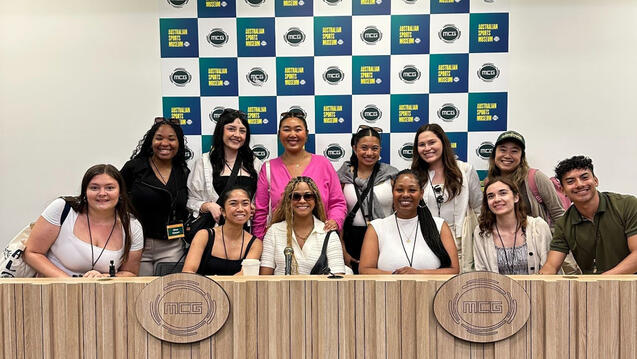
Students experienced this firsthand through programs designed to expand access and foster inclusion, leaving a lasting impression on many students. Nolan recounts, “Participating in the Leagueability program shifted my understanding of ‘community relations’ from a corporate concept to a meaningful, in-person experience.” What had once been understood as a function of marketing or outreach became something more tangible, something human.
For others, the transformation was less about a single moment and more about a gradual shift in perspective. Kelly Luz ’26 described returning from the experience with a completely new lens on the industry: “It has changed my perspective on the global sports industry.” Through interactions with organizations that prioritize relationships, culture, and long-term impact, sport became less about transactions and more about connection and purpose.
This broader perspective is further shaped by Australia's approach to sport at a national level. Through conversations around the Brisbane 2032 Olympic and Paralympic Games, students saw how sport can be used as a catalyst for long-term development. The focus extends beyond the event itself to include infrastructure, sustainability, and regional growth.
This approach challenges traditional assumptions. Instead of viewing sport as a moment, students begin to understand it as a strategy, one capable of shaping communities, economies, and identities over time.
By the end of the immersion, students leave with more than knowledge, they leave with context and a deeper understanding of how sport operates across cultures and systems, and how it can be used to create impact. In doing so, they return better prepared to engage with a global industry that demands not only expertise, but perspective.