USF Sport Management Names Rocky Harris ’02 2026 Alumni of the Year

The University of San Francisco MS in Sport Management program has named Rocky Harris ’02 its 2026 Alumni of the Year.
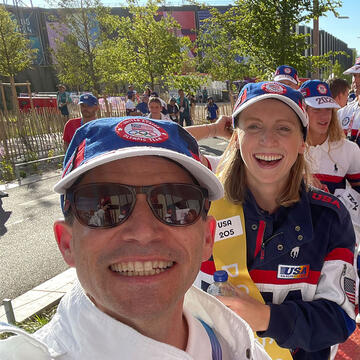
Harris currently serves as Chief of Sport & Athlete Services at the United States Olympic & Paralympic Committee (USOPC), where his leadership has helped drive some of the most successful stretches in Team USA history, including twice serving as Chef de Mission at the Paris 2024 Summer Olympics and the Milano Cortina 2026 Winter Olympics.
Harris’s path has covered nearly every corner of the sports industry. After his early years in the NFL with the 49ers and Houston Texans, he moved into the corporate sector as director of sports and marketing sponsorships at Reliant Energy, where he helped oversee what was then the largest naming-rights deal in NFL history (NRG Stadium). He went on to become chief marketing officer and senior vice president for Major League Soccer’s Houston Dynamo and AEG Global Partnerships, helping launch a $110 million downtown Houston stadium project and doubling the club's season-ticket base and sponsorship revenue. From there, Harris returned to his undergraduate alma mater, Arizona State University, spending more than five years in the athletics department and rising to Chief Operating Officer, where he oversaw day-to-day operations for the entire athletic department, added four Olympic sports programs, including women’s triathlon, and helped the university’s fundraising arm grow donations from roughly $7.5 million to $86 million annually. That track record led USA Triathlon to name him CEO in 2017, a role he held for five years before joining the USOPC.
“One of the USF Sport Management Program’s intrinsic strengths is a vast alumni network of sports executives who have risen to the top of the industry while maintaining the values of their USF education,” says alum and Sport Management Advisory Board member Dave Almy ’96, who spearheads the award. “Nowhere is this more true than with Rocky Harris. He has transformed the organizations he’s worked with, and empowered the people in them. I can’t imagine a better person to receive our Alumni of the Year award.”
For Harris, the award came as a surprise. “I was delighted and shocked when I found out, because the previous alumni of the year, Fortune Solomon ’16 and Alyssa Nakken ’15, made transformational impacts on the sports industry,” he said. “It’s an honor to be recognized since there are so many deserving alums and leaders who graduated from the sport management program over the past 35 years.”
Harris will be formally recognized during Celebrate USF weekend on Saturday, October 24, from 1:30–3:30 p.m. in the Gleeson Library Atrium.
By the Numbers
Harris's leadership has directly shaped some of the most successful stretches in U.S. Olympic history:
- Paris 2024: Team USA won 126 medals with 257 athletes medaling across 34 sport disciplines, the most in Team USA history.
- Milano Cortina 2026: Team USA qualified 232 athletes, more than any other nation, and won 33 medals (12 gold, 12 silver, 9 bronze), a new all-time Team USA Winter Games gold medal record.
- Los Angeles 2028: As USOPC builds toward LA28, athlete support has scaled with it, including a $200,000 financial benefit for every U.S. Olympian & Paralympian who competes at each Games because of a historic $100 million donation that created the Ross Stevens Financial Security Award.
Harris has received multiple other honors throughout the course of his career, including the Pete Rozelle Award for leading the NFL’s top public relations department while with the Houston Texans, Marketing Executive of the Year by Major League Soccer while with the Houston Dynamo, the Houston Business Journal 40 Under 40 Award, and the Sports Business Journal Forty Under 40 Class of 2017.
Learn More About Rocky
A USF Grad Behind Team USA’s Athlete Experience
Rocky Harris' first big break in pro sports came from relentless outreach and one very human habit: showing up early. He chose the University of San Francisco's Master’s in Sport Management for grad school because he could work full-time and wanted to be “in a vibrant sports market.”