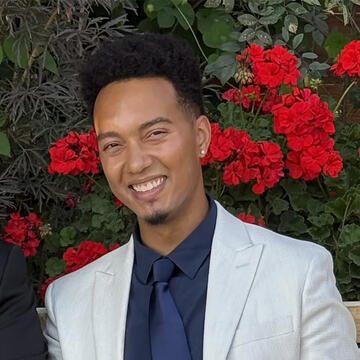
Zachary A. Reese
Assistant Professor
Biography
Dr. Zachary Reese is a social psychologist with expertise in close relationships. His research team, the Love and Communication Lab, examines how people build and maintain meaningful relationships with others.
Outside of the lab, Dr. Reese is passionate about advancing initiatives related to Anti-Racism, Diversity, Equity, and Inclusion (ADEI). He is an organizer and principal investigator for USF's Moment to Movement: Anti-Racist Pedagogy Fellows Program, a program which won the USF Collective Achievement Prize in 2023. Professor Reese hails from southwestern Pennsylvania but proudly considers many places home, including Baltimore, MD; Ann Arbor, MI; Austin, TX; and, as of 2022, San Francisco, CA.
Expertise
- Social psychology
- Teaching and learning psychology
- Anti-racism
- Building close relationships
Research Areas
- Close relationships
- Competition and social comparison
- Self-disclosure
- Personality and individual differences
Appointments
- INSJ Faculty Fellow in Civil Discourse (2026-Present)
- Faculty Development Fund Committee (2023-Present)
- Organizer, Moment to Movement Anti-Racist Pedagogy Fellows Program (2022-Present)
- Board Member, African-American Studies Minor (2022-Present)
Education
- University of Michigan, PhD in Psychology, 2022
- University of Michigan, MSc in Psychology, 2018
- Goucher College, BA in Psychology, 2016
Awards & Distinctions
- Provost's Innovation in Teaching with Technology Award, 2026
- Provost's Mentor of the Year Award, 2026
- Jesuit Foundation Grant, 2024
- University of San Francisco Collective Achievement Award, 2023
- Loyola Marymount University OER for Social Justice Grant, 2023
Selected Publications
-
Reese, Z. A., Edelstein, R. S., & Garcia, S. M. (2026). From insecurity to inspiration: Predictors of and motives for romantic partner comparisons. Self and Identity, 25(5), 555–576.
-
Reese, Z. A., & Orrach, K. (2023). Reciprocal self-disclosure: Although respondents are reluctant to steal the spotlight, self-disclosers feel validated, understood, and cared for when respondents share comparable experiences. Journal of Social and Personal Relationships, 40(11), 3485-3514.
-
Drewry, D. J., & Reese, Z. A. (2022). The effect of perceived uncertainty on competitive behavior. Academic Journal of Undergraduate Research, 18(3), 25-34.
-
Reese, Z. A., Garcia, S. M., & Edelstein, R. S. (2022). More than a game: Trait competitiveness predicts motivation in minimally competitive contexts. Personality and Individual Differences, 185, 111262.
-
Chan, T., Reese, Z. A., & Ybarra, O. (2021). Better to brag: Underestimating the risks of avoiding positive self-disclosures in close relationships. Journal of Personality, 89(5).1044-1061.