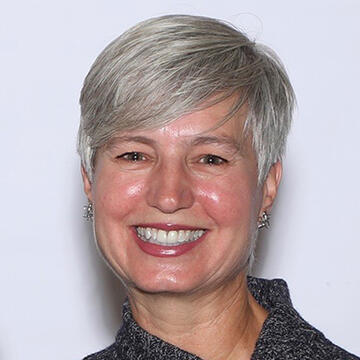
Cathy Gabor
Full Professor
Biography
Professor Gabor identifies first and foremost as a teacher. She finds joy in reading and responding to student writing. She describes her approach as "teaching at the edge of chaos" because most of her assignments ask students to interact with real world audiences through digital, oral, and written rhetoric. Her research projects, mostly classrooms studies, stem from her deep love of teaching and are often inspired by things she has learned from students.
For most of her career, Professor Gabor has occupied professional leadership roles, which allow her to collaborate with experts within and outside the university. In her spare time, she enjoys trail running, Zumba, and creating crossword puzzles. She and her spouse have two children – one graduated from USF in 2021.
Expertise
- Rhetoric and composition
- Writing in electronic environments
- Ignatian pedagogy
Research Areas
- Digital rhetoric
- Eloquentia perfecta
- Labor-based grading
- Scholarship of administration
Appointments
- Faculty Fellow, University Core Curriculum (2026-present)
- Associate Dean of Arts & Humanities (2023-2026)
- Vice-President, Full-time Faculty Union (2021-2023)
- Department Chair, Rhetoric and Language (2019-2022)
Education
- Texas Christian University, PhD in Rhetoric and Composition, 2004
- Indiana University, MA in English, 1992
- Bethany College, BA in English, 1989
Prior Experience
- Faculty, Sacramento State University (2004-2008)
- Faculty, San Jose State University (tenure granted) (2008-2012)
- Writing Program Administrator, San Jose State University (2009-2012)
Awards & Distinctions
- National Wikipedia Education Mentor, (2022, 2023, 2024, 2025, 2026)
- Full-time Faculty Service Award, College of Arts and Sciences, 2021
- Faculty Award for Technology Innovation, University of San Francisco, 2017
Selected Publications
-
“Just One More Thing?: International Students’ Perceptions of Contract Grading.” Pedagogy: Critical Approaches to Teaching Literature, Language, Composition, and Culture 24(3). (Fall 2024) Special Issue on Ungrading. 427-440.
-
“Reading, Writing, Produsing: Fostering Student Authors in the Public Space.” Digital Reading and Writing in Composition Studies, edited by Mary Lamb and Jennifer M. Parrott. Routledge, 2019. 144-160.
-
“Magic, Agency and Power: Mapping Embodied Leadership Roles” (co-authored with Tina Kazan). WPA: Writing Program Administration Journal 37.1 (Fall 2013): 134-160.